
Readiness checklist
If you are designing a warehouse or reorganising an existing one, a few decisions now mean almost no preparation later.
Layout changes should never come at the expense of efficiency in normal warehouse operations — and the drone can be adapted to different layouts with a change in its software. Large, uniform warehouses are naturally the most drone friendly: the fewer the interruptions to the repetitive, robotic behaviour of the drone, the better.

Where possible, roof support pillars should be recessed inside the shelving units, so nothing protrudes beyond the shelves that the drone might strike.

Keep shelves at a uniform and known height. Avoid randomly changing shelf height, particularly within one length of racking.

Store the height of all bin locations in your warehouse system, or in a spreadsheet for easy import into the drone controller software.

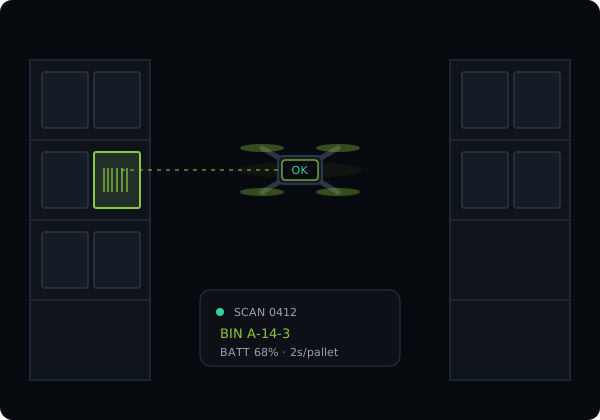
Every barcode scanned must be processed, and the drone pauses awaiting a verdict. Keep bin and item barcode symbologies separate from irrelevant ones — most packaging is EAN13, so using Code 128 or Code 39 for bins and items lets the scanner ignore EAN13 entirely and save time.

If investing in personal protective equipment, consider hard-hats with visor mounts. Propellers spin at 10,000 rpm and may break on striking an object — plastic splinters can damage an eye.

Drones are wireless devices operating on their own frequencies. Keep wireless transmissions uncluttered and at low power so they do not swamp the drone’s signals.
Holding units
Early versions of drones handle one pallet per bin location. Ensure each pallet carries a unique handling unit number — also known as a serial number — in a large barcode, in a consistent position in the middle of each pallet, stuck on straight with the barcode horizontal.
Drones will entangle in dangling wires, straps or loose packaging. The downdraught from their propellers creates turbulence that makes loose barcode labels flap and become unreadable.
Send us your layout and we will tell you honestly.